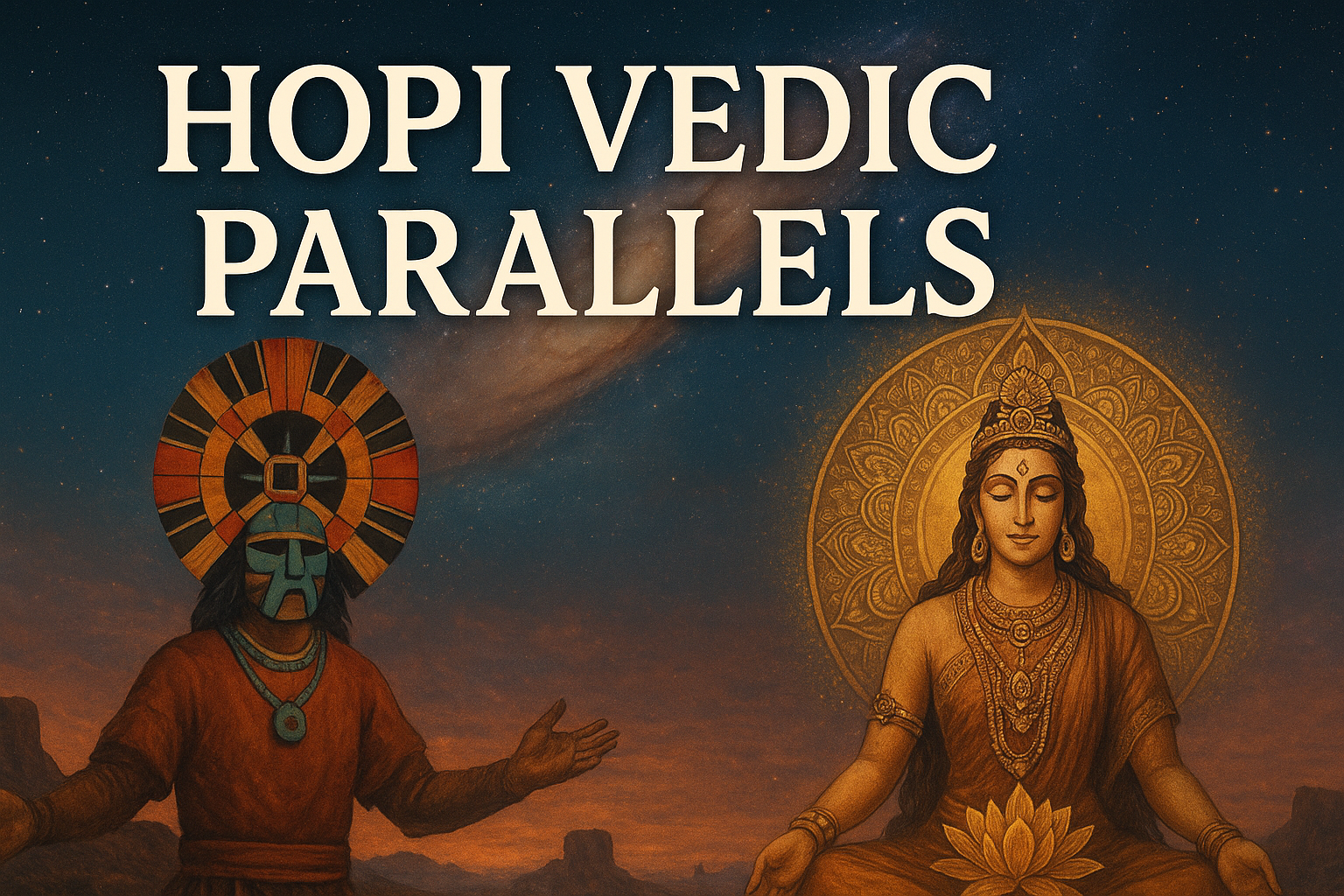

Humanity has always looked to the skies and the Earth for answers about creation, balance, and destiny. Among the many civilizations that have preserved such wisdom, two stand out for their profound cosmological insights—the Hopi tribe of North America and the Vedic tradition of India. Although these cultures arose thousands of miles apart, their spiritual frameworks reveal striking similarities, suggesting a shared universal truth about the cosmos, nature, and the role of human beings within it.
🔮 Hopi Wisdom: Guardians of Mother Earth
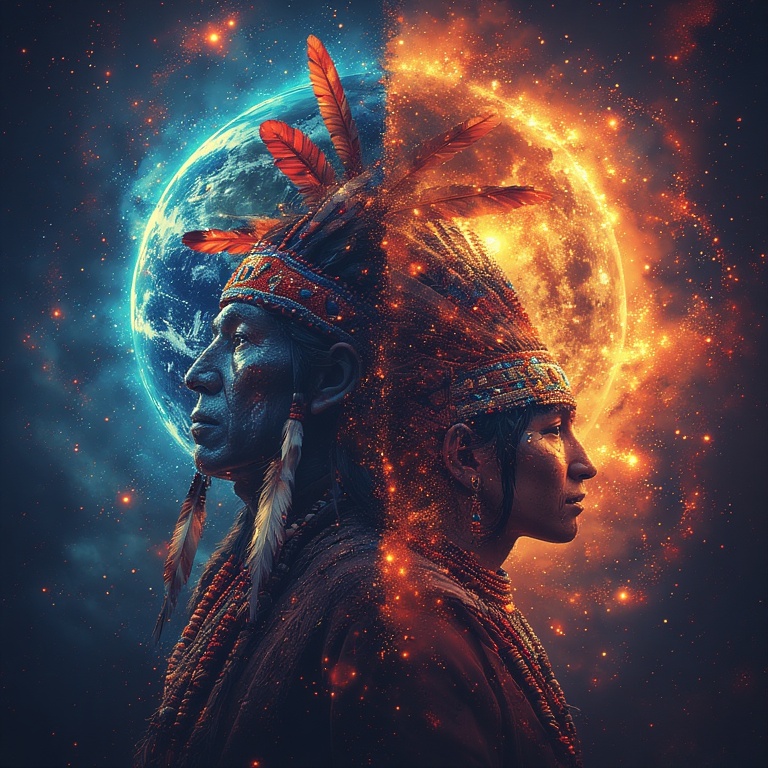
The Hopi people, often called the “peaceful ones,” hold a sacred trust as custodians of the Earth. According to their tradition, they were chosen by the Creator (Taiowa) to safeguard land and life during the emergence of the Fourth World, which represents our current age. This responsibility is not merely symbolic—it reflects their worldview that all existence is interconnected, and that humanity must live in balance with Mother Nature.
Their spiritual stories describe the Spiderwoman, a divine feminine force who weaves the web of life and establishes vibratory centers of energy across the Earth. These centers mirror the universal life force and are central to maintaining harmony between the cosmos and human beings.
🕉️ Vedic Parallels: Creation, Energy, and Kundalini
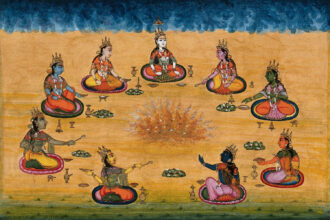
In Vedic cosmology, the Supreme Consciousness (Param Brahma or Adi Purusha) brought forth the universe through Adi Shakti, the creative feminine energy. The creation unfolds along three cosmic axes, with seven primary energy centers, or chakras, reflected both in the universe and within the human body.
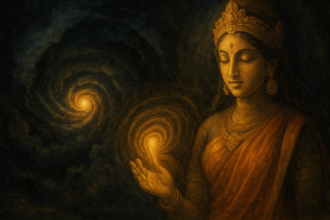
The Kundalini Shakti, resting at the base of the spine, represents the dormant spiritual energy in humans. When awakened, it rises through the chakras along the spinal axis, culminating at the Sahasrara (thousand-petaled lotus) at the crown of the head. At this stage, the individual experiences communion with the eternal Creator.
This mirrors the Hopi belief in the “Open Door” at the top of the head, a channel to connect directly with the Creator. Such parallels illustrate how both traditions emphasize inner awakening as a path to cosmic unity.
🌍 Shared Themes Across Cultures
Despite being geographically distant, the Hopi, Vedic, and even ancient Sumerian traditions converge on certain key beliefs:
- Divine Feminine as Creator:
- Hopi: Spiderwoman as the life-weaver.
- Vedic: Prakriti/Shakti as the creative force.
- Sumerians: The first humans were shaped by a goddess.
- The Power of ‘Ka’:
- Hopi: The Father Creator is Ka.
- Sumerians: Ka represents the life essence.
- Vedic: “Ka” is the root of Sanskrit and symbolizes creation itself.
- Solar Origins:
- Hopi: Taiowa, the Sun God, as the creator of Earth.
- Vedic: The Sun as the visible form of the eternal, life-giving spirit.
- Sumerians: TA.EA as the divine solar force.
- Duality and Twin Guardians:
- Many ancient traditions, from the Hopi to Egyptians and Mayans, speak of twin brothers or dual gods governing Earth.
- This symbolizes the cosmic balance of opposites—light/dark, creation/destruction—embodied in astrology by Gemini, the Twins.
- Celestial Connection:
- Hopi myths describe origins linked to the Great Bear constellation and journeys from the stars.
- Vedic scriptures also highlight cosmic beings associated with the Great Bear and the Pleiades.
🌱 Reverence for Nature
At the heart of both traditions lies an unwavering respect for the natural world. The Vedas personify natural forces—Sun, Earth, Wind, Water, and Fire—as deities, emphasizing that human survival depends on living in alignment with them. Similarly, the Hopi philosophy recognizes Earth as a nurturing Mother, warning against exploitation and imbalance.
The Hopi word “Koyaanisqatsi” captures this perfectly—it means “a life out of balance,” reflecting the ecological and moral crises of modern civilization. Their message is a call to return to harmony before humanity destroys its own foundation.
🔔 A Shared Call for the Future
The Hopi prophecy of the Lost Brother Pahana, who will return to guide humanity, resonates with global myths of a savior figure across religions and civilizations. Likewise, the Vedic tradition speaks of divine incarnations appearing throughout ages to restore dharma (cosmic order).
This convergence shows that humanity, regardless of culture, has always sought guidance to realign with truth during times of chaos.
✨ Conclusion
The parallels between Hopi cosmology and Vedic philosophy remind us that spiritual wisdom transcends geography and history. Both traditions emphasize:
- Inner awakening through divine energy.
- Reverence for nature as sacred.
- Recognition of cosmic cycles and balance.
- Faith in renewal and guidance during crises.
In an era where climate change and ecological imbalance threaten survival, these timeless insights urge us to live with humility, respect, and harmony with Mother Earth. The voices of the Hopi and the Vedas, echoing across centuries, serve as guiding lights for a sustainable and spiritually awakened future.