
In continuation of the first part of our discussion on the Metaphysics of Law – II, Inverted Anarchy aka Mathomathis now turns to explore the Rigveda, Nasadiya Sukta & The Creative Principle.
Deification in the Rigveda
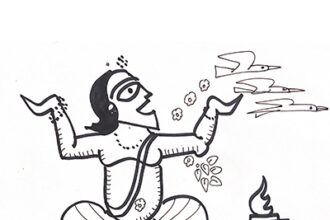
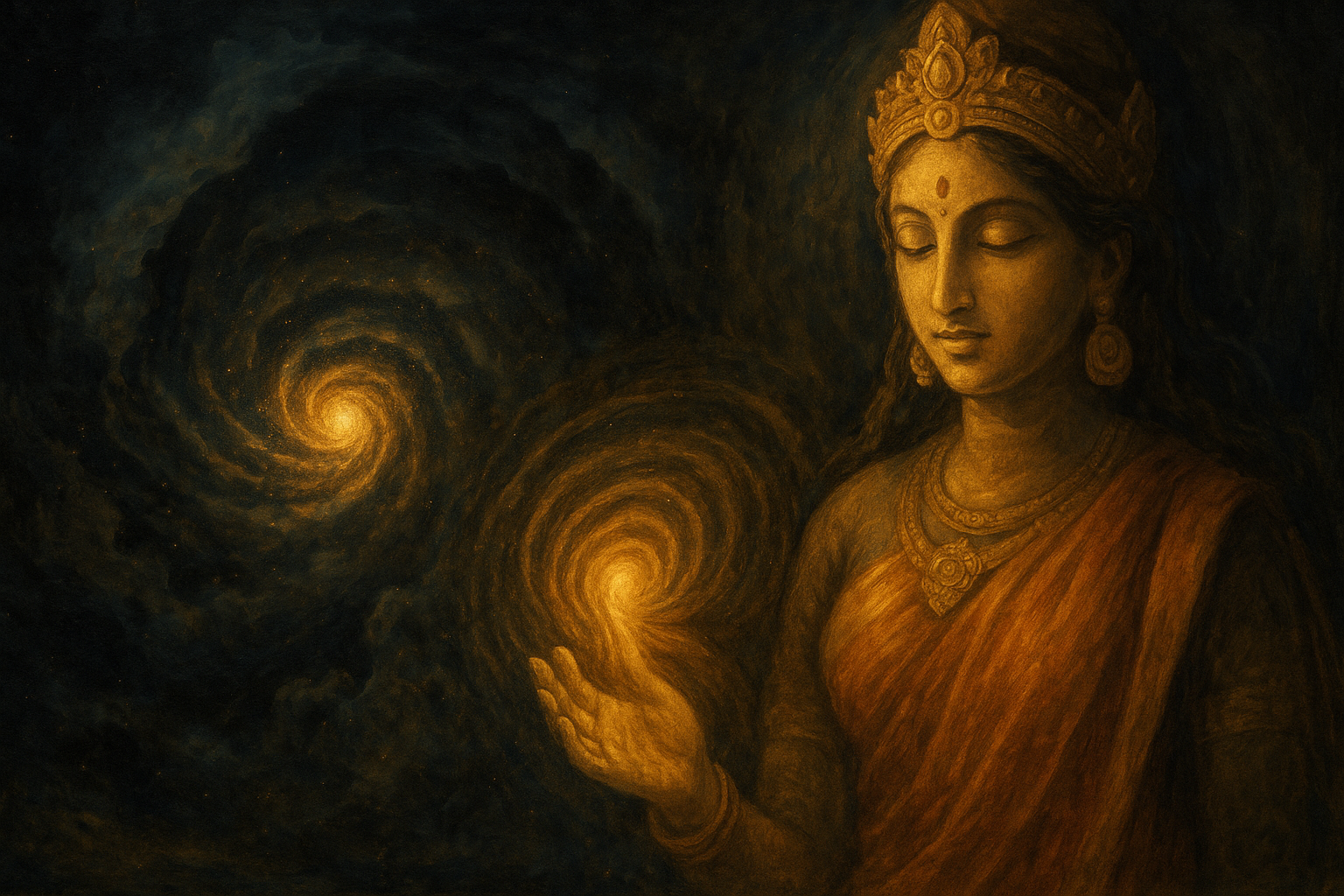
The Rigveda begins its exploration of metaphysics with the Devi Sukta, where Vak (the Word) is identified with the goddess. Much like the “Word” in the Gospel of Saint John, Vak represents the primal vibration—sound in ether—that initiates psycho-physical evolution. By personifying Vak as Devi, the hymn reveals speech as not merely communication, but the fountain-force of psychological and cosmic creation.
The Devi Sukta portrays the goddess as infinite, all-pervasive, and even the sustainer of appetite through Annam (food). Here, food is more than nourishment—it symbolizes the rupture of creation through procreation, where the primal creative energy descends into carnal life.
The Auto-Erotic Principle
The Vedic seers described the primal law as self-charged will—a passionate impulse to create. The Nasadiya Sukta vividly captures this state: before creation, there was no day or night, life or death, real or unreal—only balance. Suddenly, an inner upheaval, an invincible desire (Kāma), stirred the infinite into creation.
This auto-erotic principle—the will-to-create—echoes across traditions:
- Schopenhauer called it the Will.
- Freud recognized it as libido, the subtle erotic drive.
- Hindu thought calls it Śakti, the latent potency.
Thus, the infinite law is not static but a dynamic, self-impelled striving, ever eager to manifest.
From Nescience to Sentience: Ratri and Ushas
The Ratri Sukta describes the goddess Night as both concealing and revealing, destroying ignorance (Tamas) yet giving birth to Dawn (Ushas). This is the metaphysical allegory of consciousness emerging from unconsciousness, sentience from nescience, light from darkness.
The Brihadaranyaka Upanishad echoes this with its famous appeal: “From darkness, lead me to light”. The night is not mere absence of light, but the womb of light itself, holding creation in potentiality.
The Fluid Principle and Dual Causality
Both the Nasadiya and Devi Sukta agree that the primal state was a fluid abyss (Ambh, Apah, Vat). Fluidity is essential, since only flux can birth dynamic creation. This primal fluid became the dual causality:
- Life (Prana) – the animating breath, spirit, consciousness.
- Matter (Rayi) – the receptacle, material base, or form.
Greek philosophers mirrored this:
- Aristotle spoke of form and matter.
- Plato’s Timaeus described demiurge (active cause) and receptacle (material cause).
In the Upanishads, this duality is likened to Sun (life) and Moon (matter), male and female, seed and soil. Creation is always the union of opposites.
Myth, Symbolism, and Cosmic Law
Vedic seers conveyed these profound metaphysical insights through symbolic myths:
- The Sun (Vishnu) became the all-pervasive soul and giver of rains, sustaining cereals and life.
- Brahma, seated on Vishnu’s navel, symbolized the nucleus of creation—like a primer sparking energy release.
- The Madhu-Kaitabha legend in the Markandeya Purana represents the polarity of life (Madhu, honey/serum) and death (Kaitabha, consumer). Their destruction signifies the fusion of creative and destructive forces, giving rise to mortal beings bound in cycles of life and death.
Such allegories translate abstract metaphysics into psychological and natural law, bridging the gap between philosophy and religion.