
In continuation of the first part of our discussion on the Metaphysics of Law – III, Inverted Anarchy aka Mathomathis now turns to explore the final article which is on – Law, Freedom, and the Infinite.
Source of Natural and Positive Law
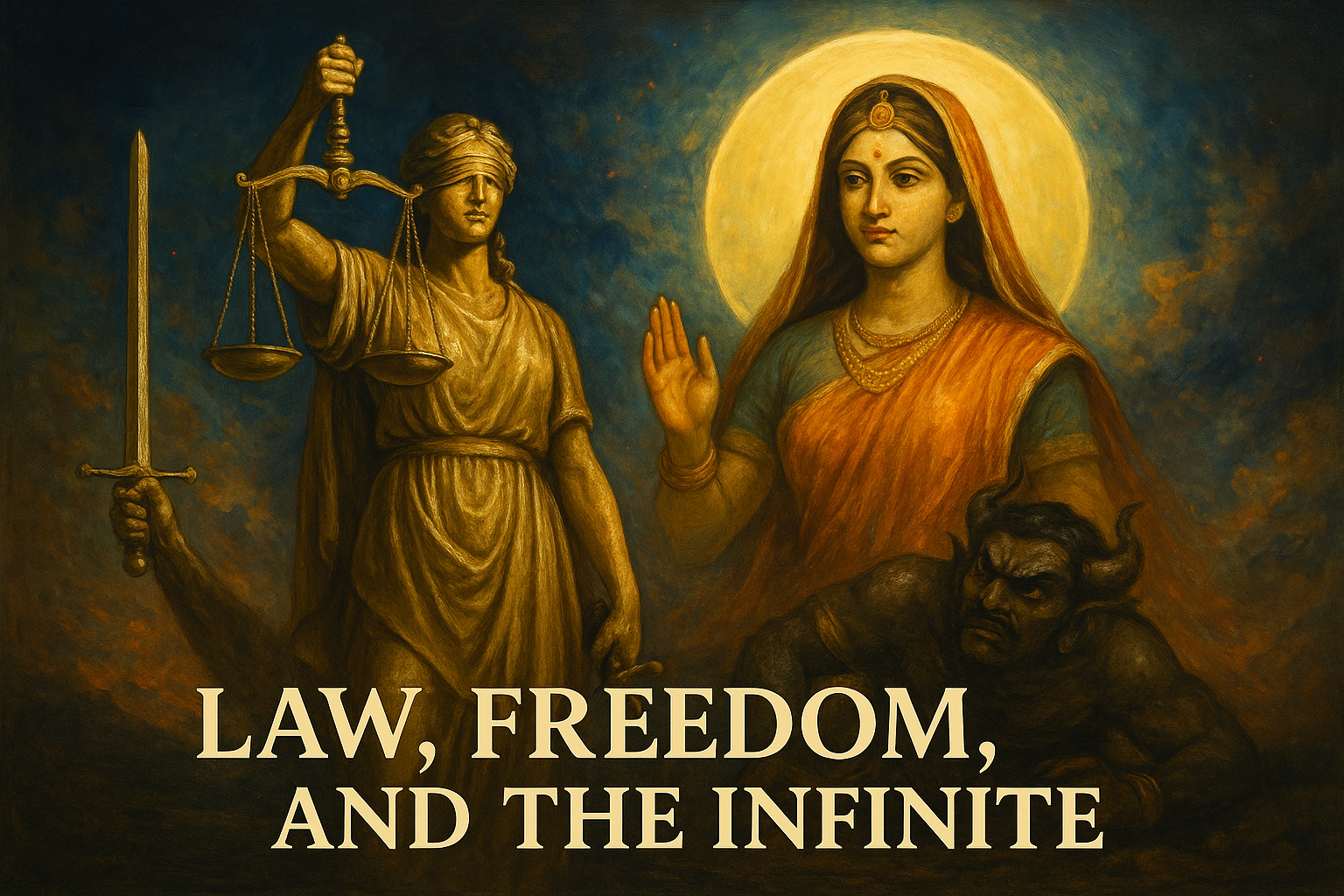
In Vedic philosophy, the devas (gods) and asuras (demons) are not merely mythological figures—they are allegories of cosmic principles. Politically, asuras symbolized invaders; historically, they represented the aborigines repelled by Aryans; socially, they stood for disruptive elements; and psychologically, they embody the darker tendencies within human beings.
The triumph of the goddess (Devi) over the asuras signifies order conquering disorder—the eternal operation of natural law in the cosmos and positive law in society. This allegory provides a metaphysical foundation for understanding law as both a cosmic principle and a social necessity.
The Idea of Law in Nature
In the natural sciences, the concept of law arises from the uniformity of events. Day and night recur because of Earth’s diurnal motion. Fire always burns, and water always wets. This predictable sequence is what we call law.
Law, therefore, is not an arbitrary rule—it is the plan inherent in the principle of existence. Each element of nature fulfills its essence:
- Earth realizes itself in motion.
- Fire realizes itself in burning.
- Water realizes itself in wetting.
Any attempt to deny or manipulate these intrinsic natures requires violating law itself—like trying to stop Earth’s rotation to eliminate day and night. Thus, law is the consummation of purpose, the unfolding of the essence of things.
Breach and Aberration in Law
Even in nature, deviations exist—floods, epidemics, disasters. These are not contradictions of law but rather aberrations within the larger scheme. The difference lies in degree:
- Nature is nearly perfect, with rare deviations.
- Humanity, with greater imperfection, frequently transgresses law.
Human lapses, however, are not meaningless—they are trials and errors in the meditative journey of life towards perfection.
The Infinite and the Finite: A Cyclical Law
The ultimate reality is infinite, but by its very law, it must manifest itself as finite. This descent is not a fall from grace but the infinite realizing itself through limitation.
- The infinite, in becoming finite, transfers imperfection into finite existence.
- The finite, in striving, returns toward the infinite.
Thus, law operates in cycles: from infinite to finite, from unity to multiplicity, and back again. This eternal rhythm reconciles freedom with necessity, perfection with imperfection.
Freedom and Necessity
The distinction between infinite will and finite will lies at the heart of law:
- Infinite Will is bound only by its own law. Its freedom is self-determined and absolute.
- Finite Will enjoys voluntariness—it can choose, err, and transgress. Even under coercion, a human retains the freedom to will differently.
This finite freedom is paradoxical. It allows transgression of limits—tasting the “forbidden fruit”—but each transgression expands consciousness toward higher freedom. Progress, then, is measured in the gradual enlargement of freedom and limitation, from individual to family, tribe, state, and ultimately unity with the infinite.
Law as a Bridge Between Freedom and Unity
Law is itself a limitation devised to dissolve limitations. It reconciles the differences of “I” and “you” into a shared order. At higher levels, laws of smaller systems fade into insignificance—like club rules vanishing before international law.
At its highest reach, law dissolves into oneness, liquidating the finite into the infinite.
The Paradox of Law in Human Life
The law introduces paradox into finite life. The self, divided between subjective and objective perspectives, may at times obey law while desiring to escape it. Humans expect others to abide by rules even when they themselves transgress. This duality is the “scandal of law.”
Thus, positive law—social and political law—becomes the finite reflection of the infinite law of reality. It is not merely regulation but part of the cosmic march from limitation to freedom, from multiplicity back to unity.
Conclusion
The metaphysics of law reveals it as more than mere human construct—it is the eternal rhythm of reality. Law is the traffic between freedom and necessity, the bridge between finite and infinite, the plan inherent in existence itself.
From the cycles of nature to the struggles of human society, law is both limitation and liberation—a gradual march toward the ultimate freedom of the infinite.
Final Conclusion: The Metaphysics of the Law
Across the four explorations, one truth emerges with clarity—law is not merely a social convention, but the very pulse of existence itself. From the cosmic dance of devas and asuras to the uniformity of fire burning and water wetting, from the rise of human societies to the eternal rhythm of infinite and finite, the principle of law reveals itself as both limitation and liberation.
Law is the bridge where freedom meets necessity, where human imperfection strives toward divine perfection, and where multiplicity gradually returns to unity. The Vedic vision of law is not punitive but evolutionary—it is a guiding intelligence that reconciles chaos with order, error with growth, and the finite with the infinite.
Every transgression, every trial and error of humankind, is not a fall from grace but a step in the upward march of consciousness. The finite self, endowed with freedom, tests its limits only to expand them, while the infinite self, bound by its own law, manifests through multiplicity only to rediscover unity.
In this grand metaphysical scheme, law is not just rules written by man, but the eternal rhythm of reality itself. It is the plan inherent in being, the will of the infinite, and the destiny of the finite. To live by law is to live in harmony with both the cosmos and the self—to recognize that in every limitation lies the seed of freedom, and in every act of freedom lies the return to unity.
Thus, the metaphysics of the law reminds us:
- Law is not external—it is the essence of existence.
- Freedom is not absolute chaos—it is disciplined self-realization.
- Unity is not imposed uniformity—it is the natural culmination of multiplicity.
In the end, the law of reality is nothing less than the law of becoming—the eternal movement from imperfection to perfection, from disorder to order, and from the finite to the infinite.