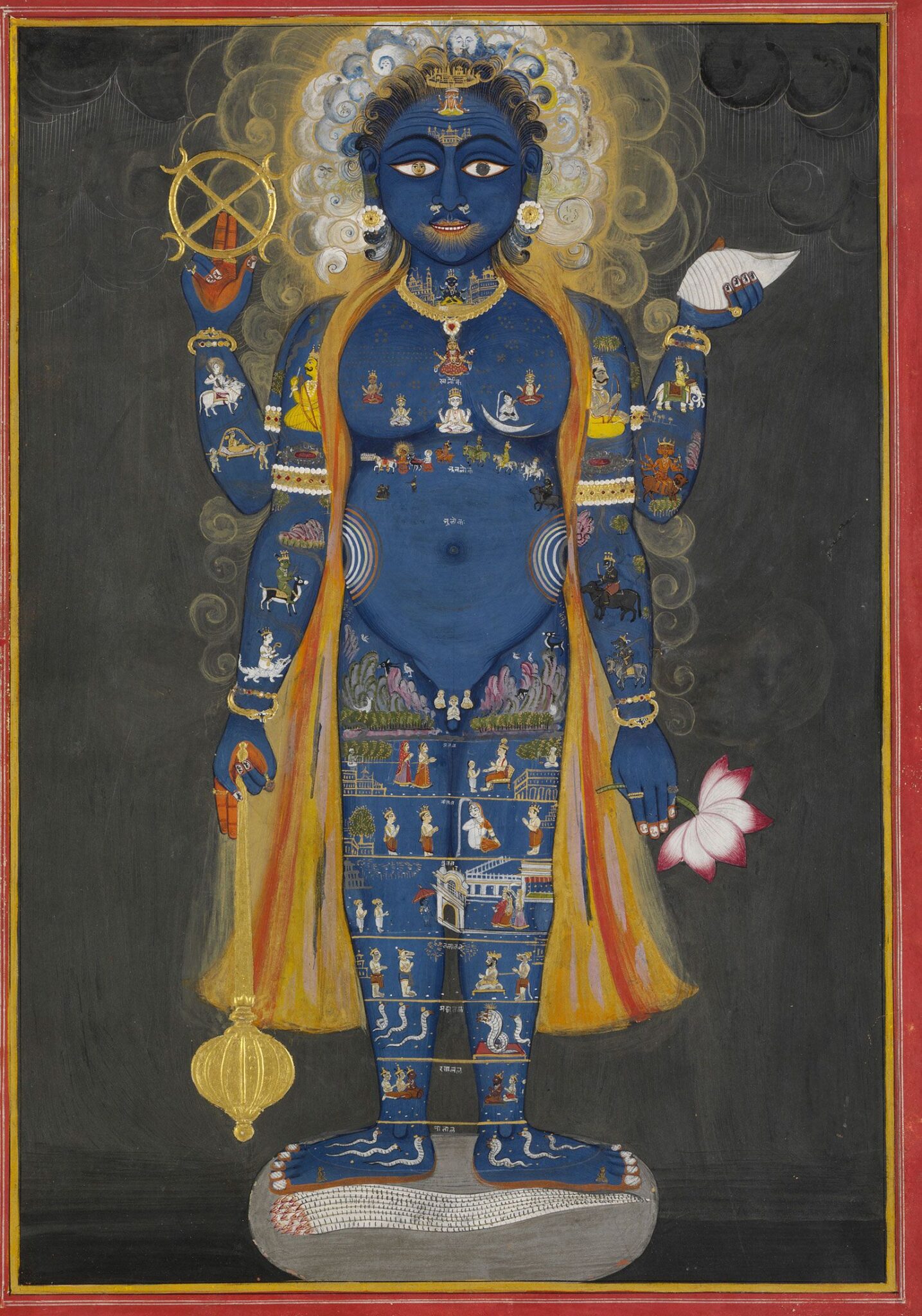

Mathomathis presents this article as a continuation of The Purusha Sukta | The Sacrifice of Purusha | 102, based on the theosophical interpretation of Zachary F. Lansdowne, Ph.D. Verses eleven through sixteen of the Purusha Sukta offer prescriptive models of human evolution, revealing how humanity develops within the body of the Planetary Logos through successive stages of consciousness, service, and illumination.
Humanity within the Body of the Planetary Logos
Verse 11
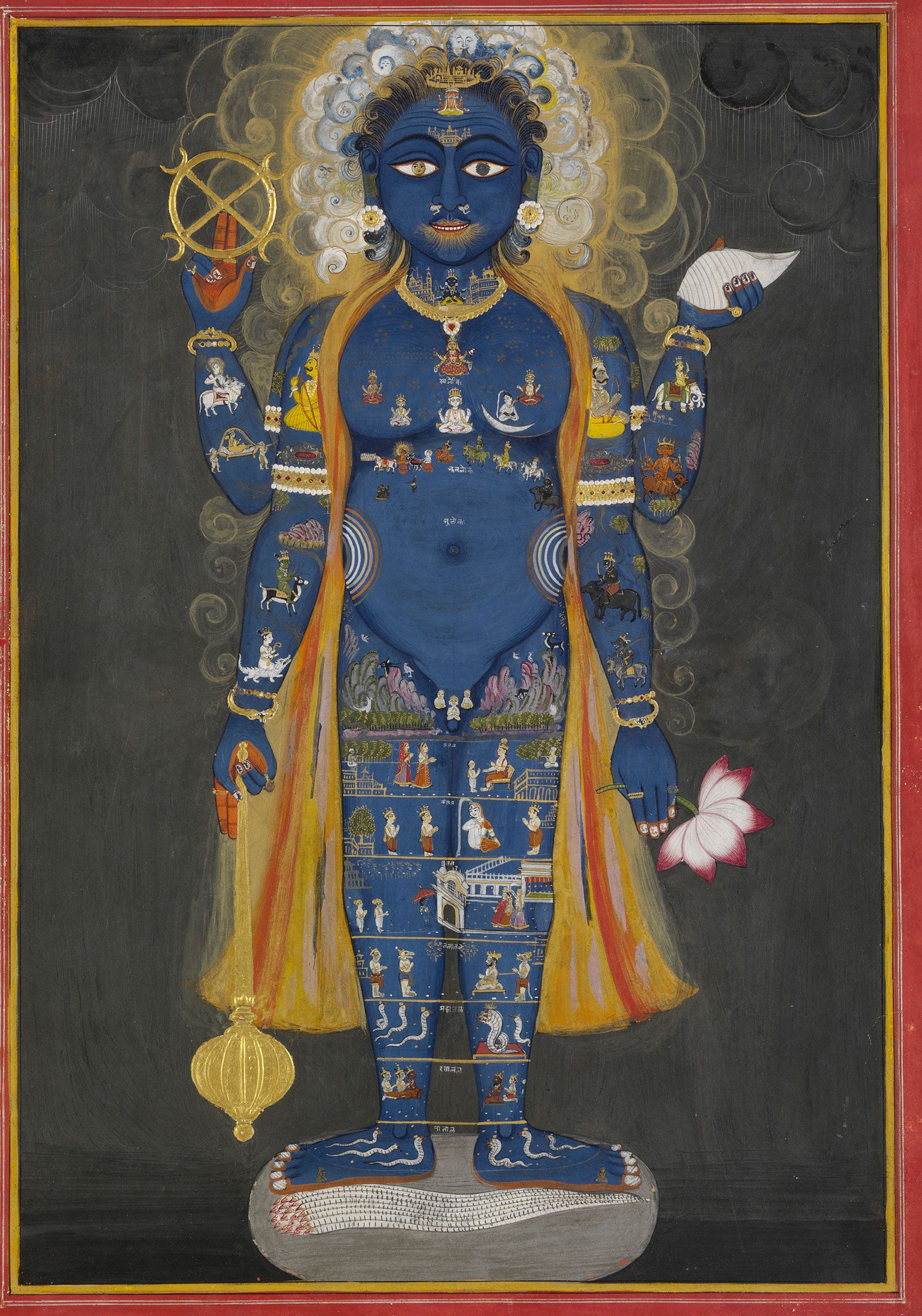
“When they divided Purusa, how many ways did they apportion him? What was his mouth? What were his arms? What were his thighs, his feet declared to be?”
This verse raises fundamental questions concerning the structure of human evolution and humanity’s place within the cosmic being. Earlier verses of the Purusha Sukta describe the physical body of the Planetary Logos as incorporating all human beings. This conception closely parallels the Christian idea that humanity forms the body of Christ. The Apostle Paul expresses this clearly:
“Now ye are the body of Christ, and members in particular.” (1 Corinthians 12:27)
If humanity collectively forms the body of the Planetary Logos, then it follows that groups of human beings at similar stages of evolution would function as distinct organs or parts within that macrocosmic body. Alice Bailey articulates a similar idea when she writes:
“The human atom is a part of a group or center in the body of a Heavenly Man, a Planetary Logos.”
Assuming that Purusha corresponds to the Planetary Logos, the verse suggests that His body is apportioned according to evolutionary stages. This approach mirrors the division of the animal kingdom described earlier in the hymn. Individuals at the same level of consciousness collectively fulfill a function analogous to that of a specific body part. The remainder of the hymn clarifies how this symbolic anatomy maps onto human evolution.
The Four Stages of Human Development
Verse 12
“His head was the Brahmana, his arms were the Rajanya, his thighs the Vaisya; from his feet the Sudra was born.”
This verse is the earliest known reference to the four traditional castes in Hindu thought and the only occurrence of them in the Rig Veda. These categories—Brahmin, Kshatriya, Vaisya, and Sudra—have often been misunderstood as hereditary social divisions. However, spiritual teachers consistently affirm that they were originally symbolic stages of inner development, not rigid social identities.
Paramahansa Yogananda explains that caste distinctions arose as spiritual symbolism but were later distorted through ego and heredity:
“The offspring of a brahmin may be a sudra by nature. And a peasant, sometimes, is a real saint.”
Yogananda interprets the four castes as stages of spiritual refinement:
- Sudra – Consciousness identified with the physical body
- Vaisya – Intelligence used primarily for personal gain
- Kshatriya – Intelligence applied for collective welfare
- Brahmin – Consciousness oriented exclusively toward the Divine
Alice Bailey describes four corresponding polarizations of consciousness: physical, emotional, mental, and causal. These stages culminate in liberation when awareness shifts from the personality to the causal body, a concept central to Hindu philosophy and acknowledged by Sri Aurobindo as the least developed faculty in most human beings.
Symbolic Anatomy and Function
The hymn further correlates these stages with body parts:
- Brahmins (mouth) — Teachers and transmitters of wisdom
- Kshatriyas (arms) — Protectors and defenders of society
- Vaisyas (thighs) — Sustainers and distributors of resources
- Sudras (feet) — Providers of support and service
Just as each body part serves the whole organism, each stage of humanity serves the planetary life according to its capacity. Thus, the Purusha Sukta presents evolution as functional differentiation, not hierarchy of worth.
Inner Illumination and the Psychology of Deities
Verse 13
“The moon was born from his mind; from his eye the sun was born; from his mouth Indra and Agni; from his breath Vayu.”
This verse operates on both macrocosmic and microcosmic levels. Here, focus is placed on the inner psychological meaning, as emphasized by Sri Aurobindo, who described the Rig Veda as a system of spiritual symbols disguised as ritual poetry.
The celestial symbols correspond to inner faculties:
- Moon (mind) — Receptivity and reflective awareness
- Sun (eye) — Vision of divine identity
- Indra (mouth) — Enlightened intelligence
- Agni (mouth) — Divine will inspired by wisdom
- Vayu (breath) — Life-energy or prana
Aurobindo interprets Indra as liberated intelligence and Agni as the will of the seer—truth-driven intention without error. Vayu, associated with prana, links breath to vitality and transformation through pranayama.
Bailey summarizes the inner process described by this verse: the aspirant forms an ideal image of the spiritual self, energizes it through illumined will, and transmits it into the lower nature until transformation becomes lived reality.
Becoming a Bridge Between Worlds
Verse 14
“From his navel arose the air; from his head the heaven evolved; from his feet the earth; the directions from his ear. Thus, they fashioned the worlds.”
This verse describes how evolved human beings become mediators between spirit and matter.
Each symbol corresponds to a developed capacity:
- Navel (solar plexus → air) — Emotional sensitivity transmuted into intuition
- Head → heaven — Union with higher spiritual planes
- Feet → earth — Service rendered on the material plane
- Ear → directions — Inner hearing and discernment
Bailey explains that the solar plexus, once purified, becomes a gateway to intuitive awareness. Concentration at the head center elevates consciousness beyond mental limitation. Service grounds spiritual realization into practical expression. Inner hearing allows discernment between impressions arising from the subconscious, other minds, the soul, and the spiritual hierarchy.
Through these faculties, human beings fashion the worlds—not by creating matter, but by linking spiritual intention with material execution.
Humanity’s Evolutionary Mission
Bailey describes the culmination of human evolution as planetary service:
“Its mission is to act as a bridge between the world of spirit and the world of material forms.”
The Purusha Sukta thus presents human evolution not merely as personal liberation but as cosmic responsibility. As individuals awaken, humanity collectively fulfills its destined role within the body of the Planetary Logos.
Concluding Insight
Verses eleven through fourteen of the Purusha Sukta articulate a profound vision of human evolution—one in which consciousness ascends through defined stages, assumes functional roles, and ultimately serves as a conduit between heaven and earth. Humanity is neither accidental nor autonomous, but an integral organ within a living cosmic being.
In this vision, evolution culminates not in domination or escape, but in illumined service, where wisdom, will, and love converge to shape the destiny of worlds.