
Mathomathis presents this article on the Purusha Sukta based on the theosophical interpretation developed by Zachary F. Lansdowne, Ph.D., former President of the Theosophical Society in Boston and a frequent contributor to The Esoteric Quarterly. Lansdowne is also the author of The Revelation of Saint John, a verse-by-verse study of the Book of Revelation, reviewed in the Fall 2006 issue of The Esoteric Quarterly.
The Purusha Sukta is one of the most profound hymns of the Rig Veda. It celebrates the primordial sacrifice of a cosmic being known as Purusha, from whom the universe, society, and consciousness emerge. This hymn continues to be chanted in Hindu worship even today. At the same time, modern scholars often regard it as obscure, paradoxical, and difficult to interpret. Lansdowne’s theosophical reading proposes that Purusha corresponds to the concept of the Planetary Logos, offering a coherent metaphysical framework through which the hymn can be understood.
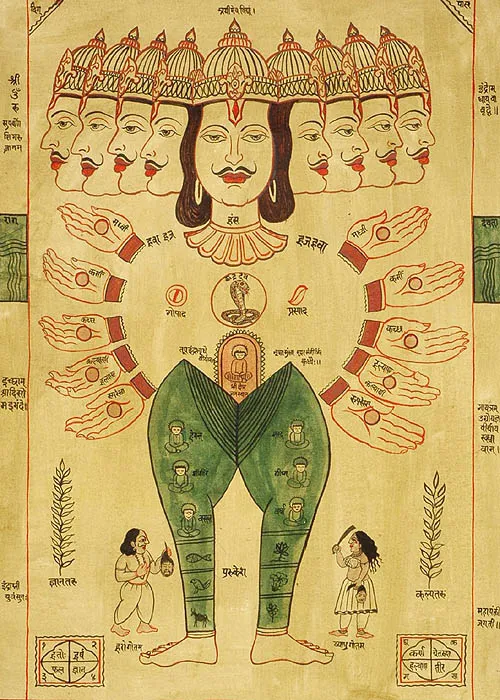
The Purusha Sukta and Its Transmission
The Rig Veda, the oldest surviving text of Hinduism, consists of 1,028 Sanskrit hymns and is generally dated between 1700–1100 BCE. The earliest known version of the Purusha Sukta appears in this text, although later recensions with modifications occur elsewhere in Vedic literature.
Notably, the Purusha Sukta is among the few Rig Vedic hymns still actively used in contemporary Hindu ritual life. The President of the Ramakrishna Mission, Chennai, observes:
“This Sukta finds a place even today in the worship of a deity, in a temple or at home, in the daily parayana [chanting], in establishing the sacred fire for a Vedic ritual, in various rituals, and even in the cremation of a dead body.”
Traditional accounts attribute the hymn to the ancient seer Nārāyaṇa. Swami Krishnananda, former General Secretary of The Divine Life Society, describes the mythic stature of this origin:
“The Seer (Rishi) of the Sukta is Narayana, the greatest of sages ever known… Such is the Rishi to whom the Sukta was revealed and who gave expression to it as the hymn on the Supreme Purusha.”
Obscurity and Esoteric Meaning
The Purusha Sukta contains sixteen verses, composed in the oldest preserved form of Sanskrit. Its language is ritualistic, symbolic, and layered. Certain words carry multiple meanings, while others may have lost shades of significance over time. For these reasons, modern scholars frequently describe the hymn as obscure.
John Muir refers to it as “another important, but in many places obscure, hymn of the Rig Veda.”
Zenaide Ragozin writes that it is “exceedingly obscure and of entirely mystical import.”
Rein Fernhout calls one of its verses “a cryptogram.”
Steven Rosen asks whether its paradoxes function as “a Zen koan, a mystical riddle, or a product of the Vedas’ incomprehensibility.”
In contrast, Helena Blavatsky, co-founder of the Theosophical Society, insists that the hymn possesses a coherent esoteric structure:
“It is those scholars only who will master the secret meaning of the Purushasukta, who may hope to understand how harmonious are its teachings and how corroborative of the Esoteric Doctrines.”
Blavatsky further explains that the sacrificial Purusha represents the Heavenly Man, whose self-offering generates the universe. Although she never wrote a systematic commentary on the Purusha Sukta, her insights laid the foundation for later theosophical interpretations.
Purusha as the Planetary Logos
In what follows, each verse of the Purusha Sukta—translated by Michael Myers, Professor of Philosophy of Religion—is followed by an interpretive commentary. This commentary presents Purusha as the Planetary Logos, drawing primarily from the writings of Blavatsky and Alice A. Bailey.
Bailey uses the terms Heavenly Man and Planetary Logos interchangeably, stating:
“Human beings are the cells in the body of a Heavenly Man.”
She further explains that Earth is the vehicle through which our Planetary Logos expresses Himself, while His source lies beyond the solar system. Interpreting Purusha as the Planetary Logos yields a consistent and illuminating reading of the hymn.
Verse 1: The Cosmic Body
“Thousand-headed is Purusa, thousand-eyed, thousand-footed…”
This verse portrays Purusha as a being whose body incorporates all human beings while transcending the planet Earth. Sri V. Sundar renders the final phrase as “He stands beyond the count of ten fingers,” symbolizing transcendence beyond mathematics, logic, and sensory limitation.
Blavatsky offers a crucial clue:
“In these Hymns, the ‘Heavenly Man’ is called Purusha.”
Thus, Purusha is not merely a symbolic man but the cosmic life in whom humanity participates.
Verse 2: Prototype and Sacrifice
“Only Purusa is all this, that which has been and that which is to be.”
Here Purusha functions as the prototype for human beings. Just as Genesis states that humanity is created in the image of God, Bailey asserts that human beings gradually become what their divine Prototypes already are.
The “immortals” mentioned in the verse correspond to liberated beings—those who have attained moksha. In theosophical terms, this is the spiritual kingdom or Hierarchy, which works to carry out the will of the Planetary Logos.
Sacrifice here signifies not suffering but spiritual expansion—the relinquishing of limited ideals and pride in favor of greater inclusiveness.
Verse 3: The All-Seeing Eye
“One-quarter of him is all beings; three-quarters of him is the immortal in heaven.”
This verse introduces the idea of self-observation. Just as human beings can observe their personality from a higher standpoint, the Planetary Logos observes His body—which includes all beings—through His higher nature.
Bailey refers to this capacity as the All-Seeing Eye, echoing Proverbs 15:3:
“The eyes of the LORD are in every place.”
Verse 4: The Flow of Principles
“Three-quarters of Purusa went upward, one-quarter remained here.”
The verse describes the flow of will, love-wisdom, and intelligence through the Planetary Logos’ vital and dense bodies. Bailey explains that only four principles manifest in a Heavenly Man: the three higher principles and the etheric body. The dense physical body is an effect, not a principle.
Thus, humanity forms the vital body of the Planetary Logos, while the animal, vegetable, and mineral kingdoms constitute His corporeal body.
Verse 5: Illumination and Awareness
“From him the shining one was born…”
The Sanskrit term virāj—translated as “the shining one”—is interpreted here as psychological illumination. Through initiation, the Planetary Logos brings about divine lucidity in human beings. This illumination, in turn, allows humanity to become consciously aware of the Logos Himself.
Bailey describes this reciprocal awakening as self-induced contact with the divine Spirit. The paradox of light giving rise to Purusha and Purusha giving rise to light mirrors the biblical insight:
“In thy light shall we see light.” (Psalm 36:9)
The final phrase of the verse indicates that the influence of the Planetary Logos extends beyond Earth, affecting other Planetary Logoi within the solar system.
Concluding Perspective
Read through the lens of the Planetary Logos, the Purusha Sukta emerges not as a cryptic ritual hymn but as a profound metaphysical statement about cosmic sacrifice, consciousness, and the evolutionary role of humanity. What appears paradoxical on the surface resolves into a coherent vision once the esoteric framework is applied.
In this sense, the Purusha Sukta stands as a bridge between Vedic revelation and universal metaphysics, uniting ritual, philosophy, and cosmic evolution into a single symbolic act.