Mathomathis presents this article as a continuation of The Purusha Sukta | Planetary Logos | 101, based on the theosophical interpretation of Zachary F. Lansdowne, Ph.D. Verses six through ten of the Purusha Sukta describe the effects of divine sacrifice upon the forms of life on our planet and reveal how sacrifice becomes the driving force behind evolution, illumination, and ordered manifestation.
- Divine Sacrifice and the Transformation of Life Cycles
- Cyclic Evolution and the Will of the Logos
- The Planetary Logos and the Solar Logos
- Accelerated Evolution and the Birth of Humanity
- Sacred Sound and the Spiritual Kingdom
- Domestication and Ordered Living
- Inner Design and Hierarchical Guidance
- Concluding Insight
Divine Sacrifice and the Transformation of Life Cycles
Verse 6
“When the gods performed a sacrifice with the offering Purusha, spring was its clarified butter, summer the kindling, autumn the oblation.”
This verse depicts the moment when the divinity hidden within the forms of life sought added life and illumination. In response, the Planetary Logos sacrificed Himself by entering into those forms, thereby transforming mere biological life cycles into evolutionary cycles.
At first glance, the verse appears ritualistic and complex. However, its inner meaning becomes clear when viewed through the esoteric principle of invocation and evocation. Invocation refers to the appeal made by lesser lives for assistance from a greater life; evocation is the response of that greater life. The earlier verses of the Purusha Sukta describe the evocation of life and illumination from the Planetary Logos. Yet such evocation could occur only because the latent divinity within the planetary forms first invoked that response.
Alice Bailey explains this moment as the primary sacrifice of the Planetary Logos: His decision to incarnate within the planetary form. This act was not optional but inherent in His nature, for He had already identified Himself with the soul latent within all forms of life. Because of this identification, He could not refuse the invocative appeal of the “seeds of life, striving within the substance of the form, and seeking added life and light,” as described in the Old Commentary. This appeal evoked the outpouring of His divinity, expressed through will and sustained by fixed determination.
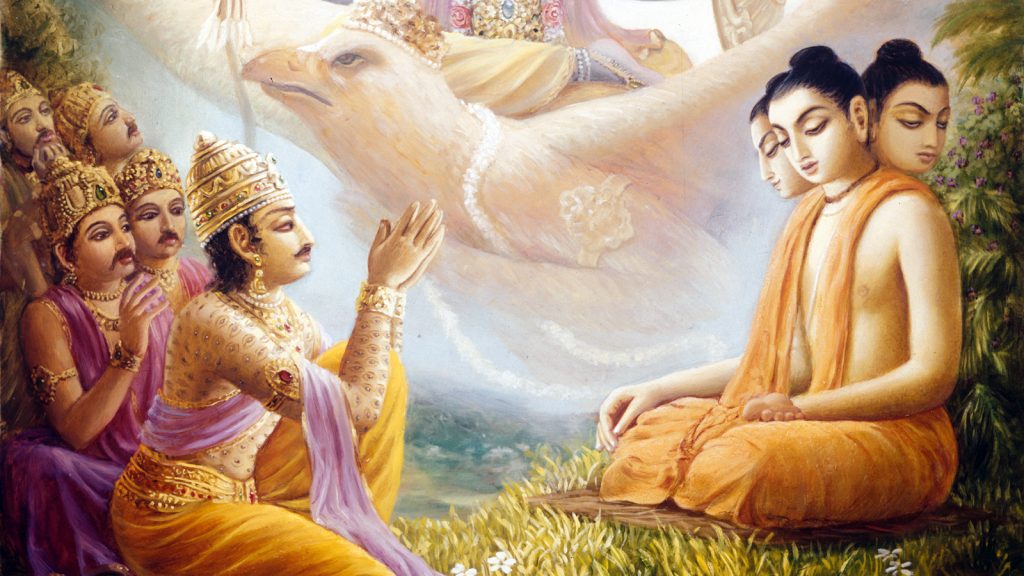
The verse also introduces the principle of evolution through symbolic seasons. Spring, summer, and autumn correspond to birth, life, and death in the annual plant cycle. These seasons are transformed into elements of sacrifice: clarified butter (ghee), kindling, and oblation. If the sacrificial fire is understood as symbolizing the evolutionary process, then the meaning becomes evident. Spring represents the birth of a new form that reveals the glory of evolution, like ghee that brightens the flame. Summer represents the period in which a form confronts its limitations and sustains the evolutionary fire, like kindling. Autumn represents the death of the form, which, like an oblation, invokes a more refined form to take its place.
Thus, the sacrifice of Purusha converts repetitive life cycles into progressive evolutionary movement.
Cyclic Evolution and the Will of the Logos
In this interpretation, “the gods” represent the divinity hidden within planetary forms. Their sacrifice with Purusha signifies the invocation that evokes the self-offering of the Planetary Logos. The transformation of seasons into sacrificial elements signifies the transformation of biological repetition into purposeful evolution.
Bailey’s explanation of cyclic evolution reinforces this interpretation:
“Cyclic evolution is entirely the result of the activity of matter and of the Will or Spirit… The active will, intelligently applied, of an Entity affects all lesser lives in cyclic evolution within the body of that Existence.”
Here, the molding Will is the will of the Planetary Logos, which earlier verses describe as flowing into both the human and subhuman kingdoms.
The Planetary Logos and the Solar Logos
Verse 7
“It was Purusha, born in the beginning, which they sprinkled on the sacred grass as a sacrifice. With him the gods sacrificed, the demi-gods, and the seers.”
This verse refers to the beginning of the current Manvantara, an immense cycle of manifestation. According to Blavatsky, a full Manvantara spans 308,448,000 years, while Bailey uses the term to describe the cycle of physical incarnation of a Planetary Logos.
At this beginning, the Planetary Logos of Earth became a center within the vital body of the Solar Logos, transmitting streams of energy from other Planetary Logoi into the forms of life within the dense physical body of the Solar Logos. In theosophy, the Solar Logos—also called the Grand Man of the Heavens—stands to the Planetary Logos as the Planetary Logos stands to humanity.
The verse provides three symbolic clues to this interpretation. First, the sacrifice occurs on “sacred grass.” Grass symbolizes the vital body, composed of innumerable channels of energy. Just as a field of grass consists of countless blades, the vital body consists of countless nadis, traditionally numbered at 72,000 in the Upanishads. By extension, sacred grass also symbolizes the vital body of the Solar Logos.
Second, Purusha is “sprinkled,” which depicts the transmission of energy, a defining function of a center within a vital body. Third, the participants in the sacrifice—the gods, demi-gods, and seers—symbolize different orders of life: the bodies of the Solar Logos, the other Planetary Logoi, and the evolving forms of life that invoked illumination.
Thus, the verse indicates that the Planetary Logos became an etheric center within the Solar Logos, a view supported by Bailey’s statement:
“The bodies of the seven Heavenly Men are the etheric centers for a Solar Logos.”
Accelerated Evolution and the Birth of Humanity
Verse 8
“From that sacrifice completely offered, the clotted butter was brought together. It made the beasts of the air, the forest, and the village.”
This verse describes a dramatic acceleration of evolution following the sacrifice of the Planetary Logos. The Sanskrit term prsadajya, translated as “clotted butter,” refers to ghee mixed with coagulated milk. As in Verse 6, ghee symbolizes the emergence of new evolutionary forms.
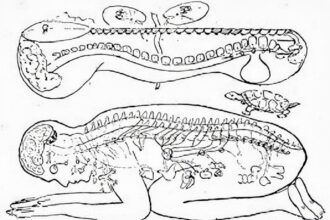
Here, evolutionary changes that would normally be spread over vast periods of time were “brought together,” meaning they occurred much more rapidly. Bailey identifies three stages in animal evolution: higher and domestic animals, wild animals, and lesser animals. The beasts of the air, forest, and village correspond to these stages, but compressed in time.
This compression allowed certain lives to pass through animal evolution swiftly and enter the human kingdom. Bailey explains that without the incarnation of the Planetary Logos, this transition would have taken inconceivably long. His sacrifice stimulated the germ of mind in animal life, resulting in the emergence of self-conscious humanity—the fourth kingdom of nature.
Sacred Sound and the Spiritual Kingdom
Verse 9
“From that sacrifice completely offered, the mantras and the songs were born. The meters were born from it. The sacrificial formulae were born from it.”
Another result of the sacrifice of Purusha was the appearance of the spiritual kingdom, which inspired humanity to produce sacred scriptures. Bailey describes this as a pivotal event that occurred approximately eighteen million years ago, when the Planetary Logos incarnated alongside highly evolved entities to form the planetary Hierarchy.
This Hierarchy functions primarily through inspiration, conveying truth to humanity in the form of mantras, songs, meters, and ritual formulae. In this way, the Rig Veda and other sacred texts emerged not as human inventions alone, but as inspired expressions of a higher order of consciousness.
The verse thus links sacred sound directly to divine sacrifice. Mantra becomes a vehicle of creative power, and poetic meter becomes a means by which cosmic order is impressed upon human consciousness.
Domestication and Ordered Living
Verse 10
“From it the horses were born… the cows… goats and sheep.”
The final verse in this section describes another effect of the sacrifice of the Planetary Logos: the domestication of animals. The Sanskrit term translated as “born” can also mean “made” or “produced,” indicating intentional cultivation rather than spontaneous generation.
Through selective breeding and intelligent training, human beings transformed wild animals into livestock, creating conditions of ordered living. Bailey affirms that this process forms part of the divine plan:
“The true and intelligent training of the wild animals… are part of the divine process of integrating the Plan and of producing an ordered and harmonious expression of the divine intent.”
Here, the will and intelligence of the Planetary Logos express themselves through humanity, guiding the animal kingdom toward harmony and utility.
Inner Design and Hierarchical Guidance
The Purusha Sukta emphasizes inner design, but not a single personal designer. Instead, it presents a universe guided from within by hierarchies of conscious beings. Blavatsky explains:
“The Universe is worked and guided from within outwards… by almost endless series of Hierarchies of sentient Beings.”
In this hierarchy, the Solar Logos guides the Planetary Logos; the Planetary Logos guides the spiritual kingdom; the spiritual kingdom guides humanity; and humanity guides the animal kingdom. Thus, sacrifice flows downward as responsibility and upward as invocation.
Concluding Insight
Verses six through ten of the Purusha Sukta reveal sacrifice not as loss, but as creative self-giving. Through the sacrifice of Purusha, life becomes evolution, sound becomes revelation, and instinct becomes intelligence. The hymn thus presents a vision in which cosmic order emerges through voluntary self-offering, guided by consciousness at every level of existence.
In this way, the Purusha Sukta stands as one of the most profound articulations of sacrifice as the engine of cosmic evolution.