
A Rig Vedic Reflection on Language, Ritual, and Truth
Mathomathis seeks to offer a reflective overview of the poetic foundations of the Vedic system, drawing primarily from the Rig Veda. One of the most remarkable truths about Indian civilization is that it began not with political organization or material expansion, but with poetry. In its earliest stages, poets played a decisive role in shaping civilization, ordering ritual life, and giving enduring form to Indian culture. This article explores Vedic poetry and philosophy as preserved in the Rig Veda, where ritual, language, and truth emerge through poetic vision.
- Ritual, Poetry, and the Social Function of the Poet
- Vedic Poetry and Philosophy in the Rig Veda
- Dīrghatamas and the Mystery of Creation
- Weaving, Text, and Poetic Creation
- Speech (Vāk), Wisdom, and the Birth of Poetry
- Metre, Immortality, and the Poet’s Destiny
- The Kavi: The Seer of Totality
- Concluding Reflection
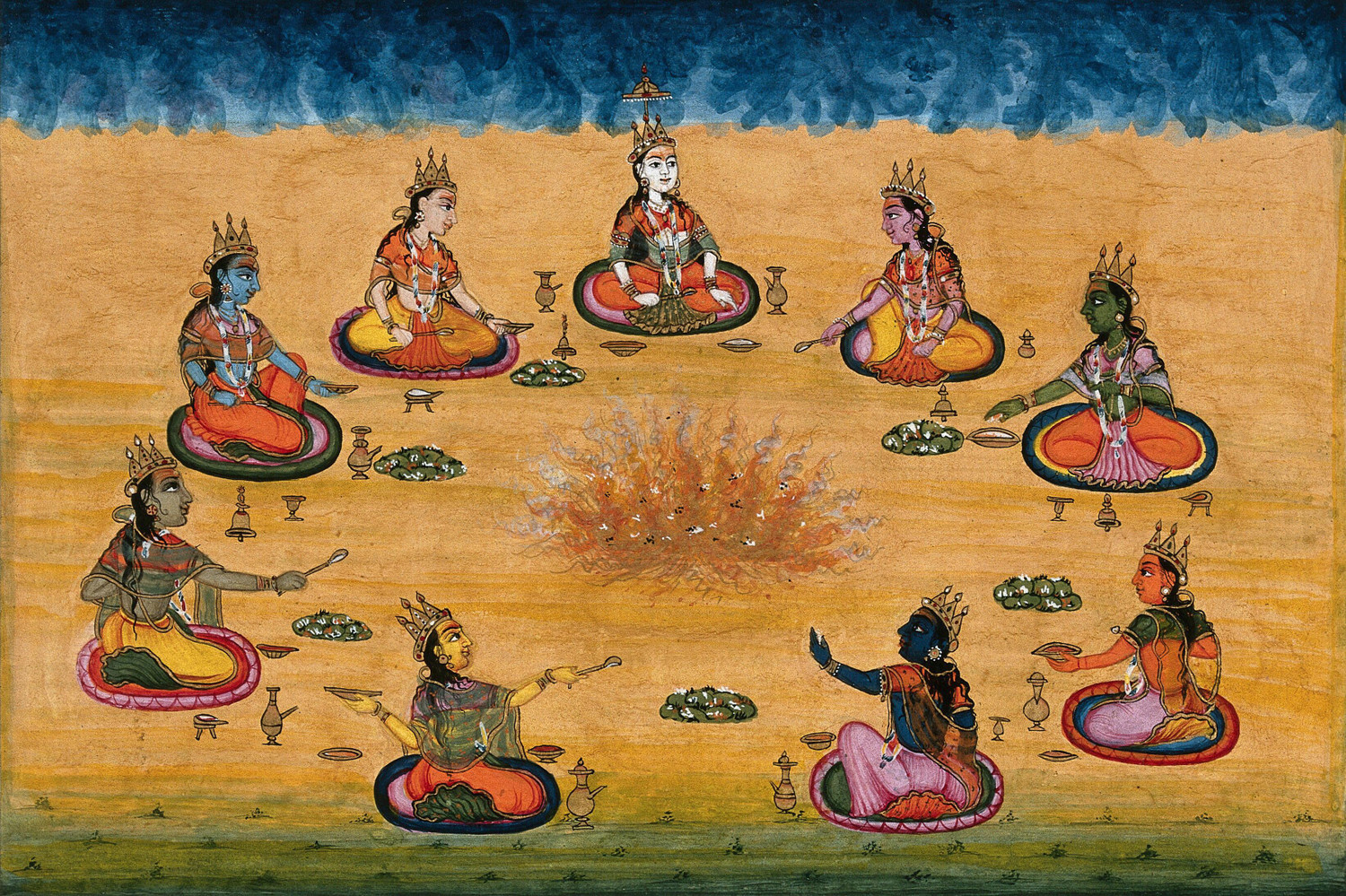
Even today, hardly anything solemn or sacred in India begins without song. Therefore, one may adapt a Tennysonian phrase to the Indian context and say that the Vedas sang the subcontinent into a civilization. Much like Greek tragedy arose from religious ceremony, Vedic poetry grew organically from ritual life itself. Singing hymns and composing verses were not aesthetic indulgences; instead, they formed essential communal acts.
Ritual, Poetry, and the Social Function of the Poet
Importantly, ritual bound the community together, and ritual itself constituted religion. Etymologically, the word religion derives from the Latin religare, meaning to bind together. For the Vedic mind, ritual and poetry moved together as close companions, each strengthening the other.
Because ritual consciousness pervades the Rig Veda, it becomes difficult to isolate examples of “pure poetry.” Poetry did not merely accompany ritual; rather, it formed an integral part of it. Consequently, poetry carried a social dimension that cannot be denied. The Vedic poet stood deeply committed to the community. Unlike the modern poet—often imagined as isolated or idiosyncratic—the Vedic poet occupied a central social role and expressed concern for cosmic order, human destiny, and humanity’s relationship with the universe.
Moreover, the Vedic poet achieved a remarkable synthesis. He unified ritual practice, poetic expression, song as art, and philosophy as cosmic inquiry. This unity echoes Pierre-Simon Ballanche’s observation:
“It is always a religious truth that the poet has to transmit. Religion and poetry are but one and the same. The poet is the priest.”
Such a synthesis defined the very quiddity of Vedic culture. However, this unity did not imply uniformity. On the contrary, Rig Vedic poetry reveals diverse philosophical tendencies, including skepticism, agnosticism, pantheism, and speculative cosmology.
Vedic Poetry and Philosophy in the Rig Veda
The Vedic poets thrived within a deeply philosophical environment. While figures such as Heraclitus expressed philosophy through poetic fragments in the West, the presence of sages like Bṛhaspati and Dīrghatamas within the Rig Veda normalizes the fusion of poetry and philosophy in India.
For the Vedic worldview, the philosopher necessarily speaks as a poet. Truth does not emerge through abstract propositions alone; instead, it manifests when poetic speech gives it form. Therefore, Vedic philosophy extends beyond metaphysics and epistemology into a philosophy of language and poetry itself.
The Rig Veda also preserves anticipations of later literary insights. For example, T. S. Eliot’s distinction between the man who suffers and the man who creates appears thousands of years earlier in the image of the two birds:
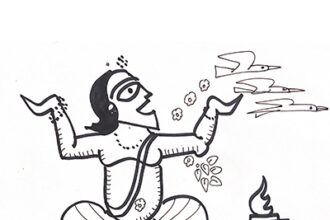
“Two birds, friends joined together clutch the same tree. One of them eats the fruit; the other looks on without eating.”
(1.164.20 O’Flaherty 1994:78)
This metaphor recurs in the Atharva Veda, Muṇḍaka Upaniṣad, Kaṭha Upaniṣad, Bhagavad Gītā XV, and even in Rabindranath Tagore’s poem “Dui Pakhi”. Clearly, Indian civilization returned repeatedly to this vision of experience and witnessing, action and awareness.
Dīrghatamas and the Mystery of Creation
Among the Vedic seers, Dīrghatamas stands out as both a master poet and a profound philosopher. He contributed twenty-five hymns to the Rig Veda, rich in symbolism and metaphysical depth. His poetry assumes an audience familiar with symbolic language—unlike the modern reader, who often struggles with paradox and layered imagery.
In one hymn, Dīrghatamas questions whether anyone has truly witnessed the creation of the universe. Through this question, he directs attention to the mysterious relation between the primordial reality and the world of experience.
“Poets seeking in their heart with wisdom found the bond of existence in non-existence.”
(10.129.4 O’Flaherty 1994:25)
Thus, true wisdom arises through vision, not mere speculation. Only poetic language can awaken the hidden universe and bring meaning into manifestation. If one understands the language of the poet, one also approaches the mystery of existence itself.
Weaving, Text, and Poetic Creation
Dīrghatamas repeatedly employs the metaphor of weaving to describe poetic creation:
“An ignorant fool, I ask in my mind about the hidden footprints of the gods. Over the young calf the poets stretched out seven threads to weave.”
(1.164.5 O’Flaherty 1994:76)
Here, poetry appears as a woven fabric of meaning. Notably, the very word text derives from the act of weaving. Long before modern literary theory, Vedic poets understood poems as structured, textured creations formed by interlacing thought, sound, and insight.
The symbolism of seven recurs frequently—seven threads, seven sisters, seven tones—signifying cosmic order. The poets, as Kavis, know how to stretch these threads with precision and insight.
Speech (Vāk), Wisdom, and the Birth of Poetry
Speech itself assumes divine stature in the Rig Veda:
“I am the one who blows like the wind, embracing all creatures.”
(10.125.8 O’Flaherty 1994:63)
Yet speech does not reveal itself to everyone:
“Whom I love I make awesome; I make him a sage, a wise man, a Brahmin.”
(10.125.5)
Wisdom unites with speech to give birth to poetry. The hymns express this union through deeply evocative imagery:
“The mother gave the father a share in accordance with the Order…”
(1.164.8)
Language becomes the mother; wisdom becomes the father; poetry emerges as the offspring. Later Sanskrit aesthetics crystallize this insight through Anandavardhana’s Dhvani theory and Abhinavagupta’s philosophy of rasa, where poets do not state meaning directly but suggest it.
The same vision appears in Kālidāsa’s Raghuvaṃśa:
vāgārthāv iva sampṛktau…
Inter-welded as word and meaning…
Language forms the body; meaning forms the soul—inseparable.
Metre, Immortality, and the Poet’s Destiny
For Dīrghatamas, metre is sacred. The highest truths find expression in Gāyatrī, which relates to the three worlds:
“With the Gāyatrī foot they fashion a hymn…”
(1.164.24 O’Flaherty 1994:78)
The true poet understands not only meaning but also appropriate metre and occasion. Through this knowledge, poetry becomes a vehicle for immortality. Unlike modern skepticism toward wisdom, the Vedic worldview treats poetic insight as the highest form of knowledge.
To become a poet means to unite mortality and immortality. The poet becomes the child of heaven and earth and takes his seat confidently at the altar of language.
The Kavi: The Seer of Totality
The Kavi embodies prajñāvat, dhyānavat, and medhāvin—a trans-visionary (kāntadarśin). He aligns his intellect with tapas, śraddhā, and disciplined perception. Thought flows without rupture, and meaning arrives whole.
Dīrghatamas captures this transformation poignantly:
“I do not know just what it is that I am like…
When the first-born of Order came to me,
I won a share of this Speech.”
(1.164.37 O’Flaherty 1994:79)
Here, poetry appears not as an achievement but as a state of being.
Concluding Reflection
In the Vedic vision, poetry does not stand secondary to philosophy or religion; instead, it serves as their womb. Through poetic language, truth becomes visible, wisdom becomes audible, and civilization becomes possible. To be a poet means not merely to compose verses but to participate in cosmic order itself.
This is not a literary theory borrowed from the West; it is a civilizational insight encoded in the Rig Veda itself.