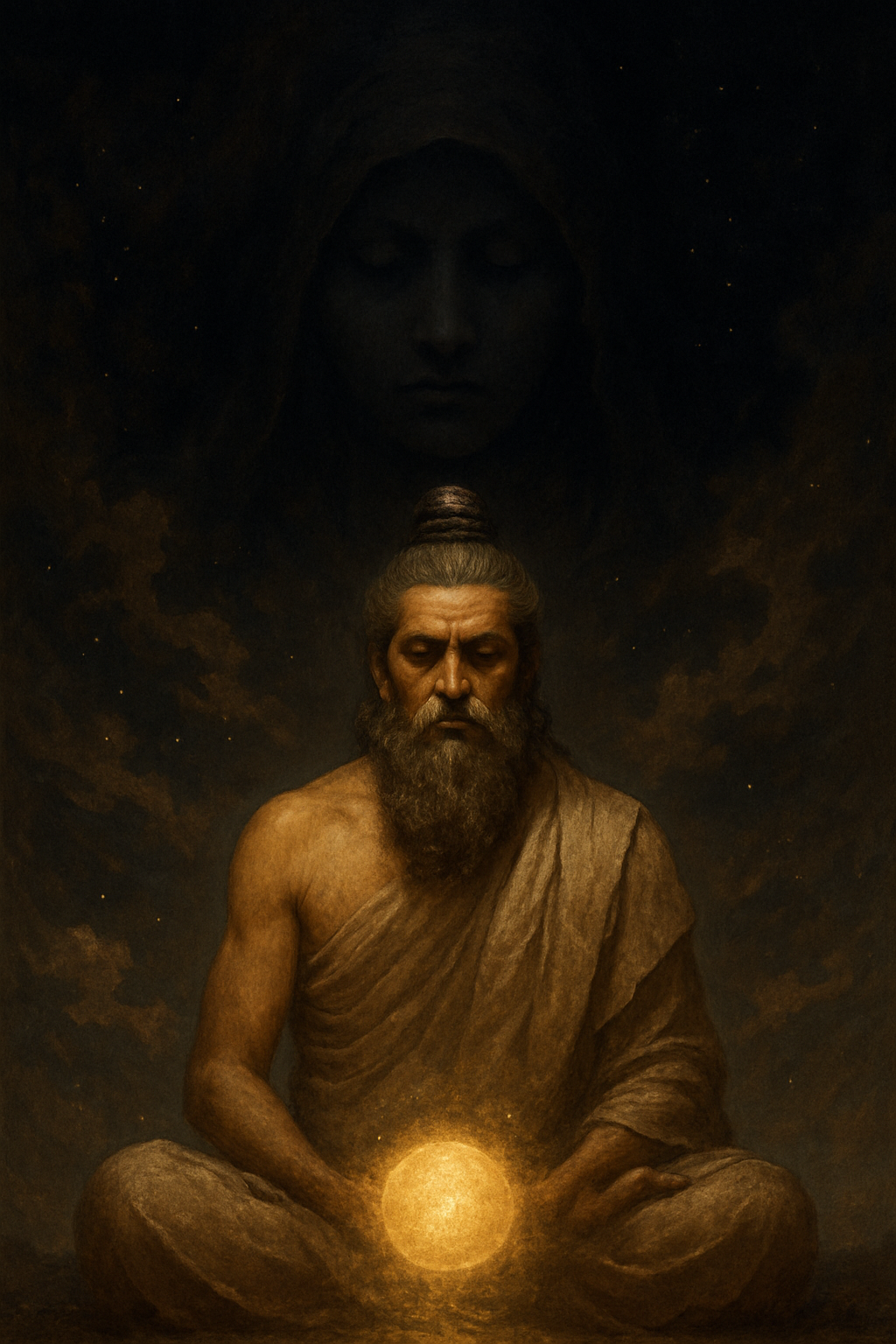

In continuation of the first part of our discussion on the Metaphysics of Law- I, Inverted Anarchy aka Mathomathis now turns to explore the state of nescience, the desire for knowledge, and how these lead to the vision and deification of law.
The State of Nescience
The state of nescience is a profound metaphysical concept. It represents a condition without predicates, without attributes—a primordial destiny that exists as a law unto itself.
The Nasadiya Sukta of the Rigveda powerfully affirms this state, describing the time before creation when neither being nor non-being was manifest. Similarly, in Henri Bergson’s Creative Evolution, intuition mirrors this nescience—an unmanifest creative force beyond intellectual grasp.
In Indian philosophy:
- The Sankhya school recognizes nescience as the concentrated potential of creative force.
- The Shakti tradition personifies it as the Supreme Goddess—energy, vitality, and power itself.
- Sri Aurobindo’s conception of the Mother also echoes this “unmanifest mystery of the Supreme.”
The Markandeya Purana describes this state as Yoga Nidra, or cosmic slumber—a poised stillness before manifestation. It is depicted as Kala Ratri (Eternal Night), Maha Ratri (Infinite Night), and Moha Ratri (the Night of Infatuation), all pointing to the same truth: an inert yet dynamic potential awaiting release.
Becoming: The Fall and the Desire to Know
From this nescient stillness arises becoming—the creative force descending into manifestation. The Genesis narrative of Adam’s fall in the Bible symbolically represents this downward movement.
The forbidden fruit reflects the latent creative power not yet actualized. In tasting it, Adam embodies the desire to know—to experience, to create, to become.
This desire is not accidental; it is the very impulse of Shakti, the elan vital of Bergson, the conatus of Leibniz. It is the restless force within being that seeks expression through becoming.
The Desire to Know: Seeds of Knowledge
The desire to know is the seed of all evolution—biological, psychological, and spiritual.
As explained in the Aitareya Upanishad, the urge to know is also the urge to experience and create. Knowledge is the bridge between:
- Perception – what we see (the tree).
- Causation – what we infer (the seed).
By seeking the seed, the knower grasps the latent force that manifests the tree. This principle applies universally: the entire cosmos once lay dormant in a reservoir of infinite force.
Thus, every tradition—whether it speaks of Shakti, Maya, Prakriti, elan vital, or forbidden fruit—points toward the same reality: the hidden creative power striving for expression.
Knowledge and the Vision of Law
When knowledge seeks causes, it ultimately arrives at the first cause—the infinite, unmanifest source.
- The law of the tree is ingrained in the seed’s force.
- Likewise, the law of creation is ingrained in the cosmic seed of being.
This realization is the metaphysical vision of law—the understanding that law is not external regulation, but the inherent tendency of creative force to manifest order.
From Metaphysics to Religion: Deification of Law
At this point, inquiry transforms into reverence. The seeker, overwhelmed by the sublimity of causation, transforms into a worshipper of the source.
- Metaphysics is the perception of truth.
- Religion is the perpetuation of that truth through symbolic forms.
The Rigveda captures this process in its hymns, where creative law is envisioned as Devi—the Goddess, embodiment of Shakti. Hymns, chants, and gods become anthropomorphic expressions of metaphysical realization.
Thus, deification is not superstition, but a symbolic method of preserving the vision of law in cultural memory.
Conclusion: From Nescience to Divinity
The journey of metaphysics takes us from:
- Nescience – the unmanifest slumber of force.
- Desire to know – the creative impulse breaking through into becoming.
- Knowledge of causation – realization of law within force.
- Deification – religion as a vessel to preserve and transmit the vision of law.
The Metaphysics of Law thus reveals how the cosmos, human inquiry, and spiritual traditions converge. All point toward one truth: that life, knowledge, and law are expressions of a single creative power, eternally unfolding from nescience into becoming, and finally into transcendence.